

Best Fitness Gear for Home Gyms: A 2026 Dad's Guide
Table of Contents
- Quick Comparison: Top Fitness Gear for Home Gyms
- The Essential Home Gym Checklist for Beginners
- Space-Saving Home Gym Equipment for Apartments and Small Rooms
- How to Build a Home Gym on a Budget That Still Gets Results
- Choosing Gear That Supports Progressive Overload for Busy Dads
- What to Skip: Gear That Wastes Money and Space
- Conclusion: Build the Home Gym That Fits Your Life
- Frequently Asked Questions
Last Updated: September 8, 2026
The biggest mistake most guys make when building a home gym is buying gear before they have a plan. The best fitness gear for home gyms isn't about filling space; it's about choosing tools that match your room, budget, and family schedule. At Fit Dad Community, we've learned the core lesson is always the same: a focused setup you actually use beats an impressive one you ignore.
Your home gym setup controls the friction between "I should work out" and "I am working out." If you have to move a car or drive to a gym, you've lost most weeknights. A smart setup puts the barrier at nearly zero, making it easier to get 20-30 minute sessions done before the kids wake up or during lunch. Below, we'll cover essential gear categories, small-space priorities, and a budget-friendly setup that supports progressive overload.
Quick Comparison: Top Fitness Gear for Home Gyms
To help you make fast decisions, here's a snapshot of the most effective equipment categories for home use, based on what actually gets used consistently in busy households.
| Gear Type | Best For | Key Advantage | Watch Out For |
|---|---|---|---|
| Adjustable Dumbbells | Strength training in small spaces | Replaces a whole rack of weights | Unique shape takes time to get used to |
| Power Rack | Serious weightlifting | Safety and stability for heavy lifts | Requires significant floor space and ceiling height |
| Suspension Trainer | Functional fitness | Extremely portable, minimal storage | Requires a sturdy anchor point |
| Smart Cardio Machine | Guided workouts | Immersive classes and connectivity | Ongoing subscription costs |
| Yoga Mat | Recovery and mobility | Joint support and non-slip grip | Heavier than standard mats |
This comparison covers the core categories we'll explore in depth. The right choice depends on your primary goal, whether that's building muscle, improving cardiovascular endurance, or maintaining flexibility and recovery.
The Essential Home Gym Checklist for Beginners
Starting a home gym doesn't require a massive investment. A practical essential home gym checklist for beginners focuses on a few versatile pieces that allow for compound movements and progressive overload, gear that grows with you, not equipment you'll outgrow.
A solid starting point includes adjustable dumbbells, which let you change resistance quickly between sets without buying multiple pairs. Add a sturdy bench for presses and rows, plus a suspension trainer for bodyweight exercises that build core strength and stability. Round out the setup with a high-quality mat for floor work, stretching, and recovery. This combination covers most major muscle groups and allows for many motion.
Space-Saving Home Gym Equipment for Apartments and Small Rooms
For dads living in apartments or homes where every square foot counts, space-efficient gear is the difference between a usable gym and a storage problem. The focus should be on equipment that folds, stacks, or mounts to the wall, allowing you to reclaim your space when the workout is done.
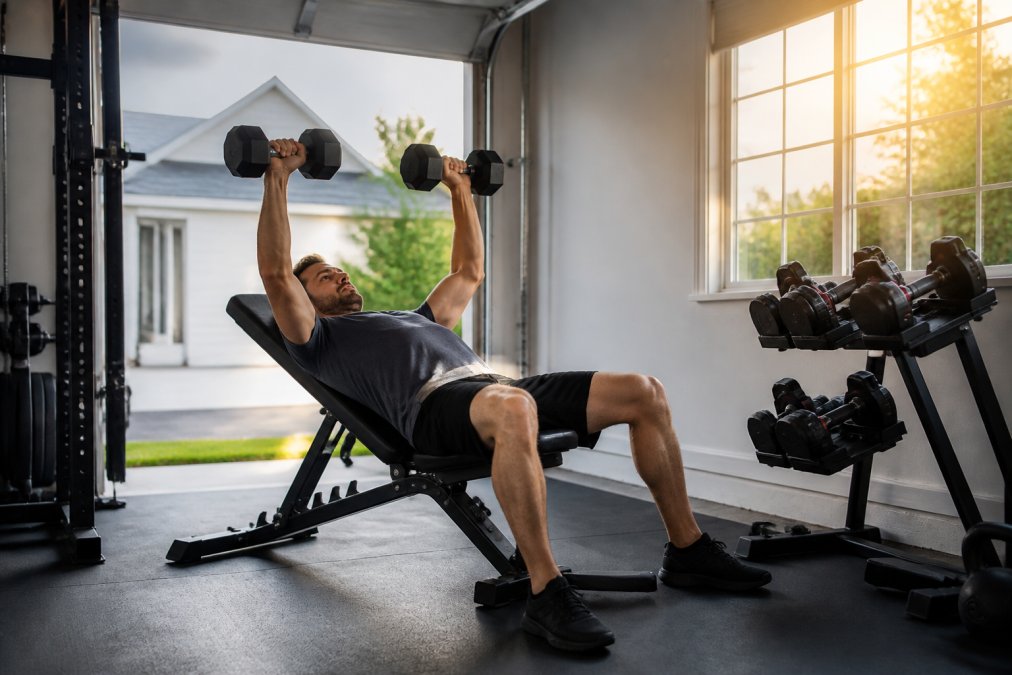
Adjustable dumbbells are the cornerstone of any small-space gym, replacing an entire rack with a single compact unit. A suspension trainer packs down to the size of a small bag and anchors to a door or ceiling beam for a full-body workout. For cardio, a foldable rowing machine offers a low-impact workout that stores upright.
The key is to think vertically and modularly. Wall-mounted storage for bars and bands, a folding bench that slides under a bed, and a multi-grip pull-up bar that fits in a doorway all maximize your footprint. This approach keeps your space livable while still giving you the tools for a challenging workout.
How to Build a Home Gym on a Budget That Still Gets Results
A common misconception is that you need thousands of dollars to build a home gym that delivers results. The truth is that a budget-conscious approach, focusing on used equipment and versatile tools, can get you 90% of the way there. However, the biggest financial win, and the biggest potential pitfall, lies in the secondary market. With inflation driving up the cost of new gear, platforms like Facebook Marketplace, Craigslist, and OfferUp have become the go-to source for budget builders. The key is knowing how to separate a great deal from a hidden liability.
The Smart Way to Buy Used Gear
The used market is flooded with equipment from people who gave up after a few months. Before you message a seller, know the new retail price. A fair used price is typically 40-60% of that, depending on condition and brand. For example, a new premium barbell at $300 makes a used one in excellent condition for $150 a solid deal, but a no-name brand at that price is not.
When inspecting an item, bring a checklist. For a power rack, check for cracks in the welds, ensure J-hooks and spotter arms aren't bent, and that adjustment pins slide smoothly. For a barbell, the most critical test is the spin of the sleeves; they should rotate freely. Check the knurling for excessive wear and look down the shaft to see if it's bent, a bent bar is a safety hazard. For plates, a drop test on a hard surface tells you if they're solid iron (rings) or filled with concrete (thuds).
What to Buy New vs. Used
While you can save big on iron and steel, some items are better bought new. Anything that contacts your body and can degrade, foam rollers, yoga mats, resistance bands, should be new for hygiene and safety. A used bench is a gamble: upholstery can harbor bacteria, and hinge mechanisms can fail, a serious safety risk. A new bench is a worthwhile investment. Be cautious with used adjustable dumbbells; the locking mechanisms are complex, and if worn, weights can slip mid-lift. Test the locking mechanism on every weight increment before buying.
The New-Gear Budget Blueprint
If building new, prioritize versatility per dollar. A single heavy kettlebell (35-53 lbs for most men) enables swings, goblet squats, and single-arm rows. Quality resistance bands (loop bands and a door anchor) provide a full-body workout and are perfect for warm-ups. A doorway pull-up bar is non-negotiable for pulling strength. Combined with adjustable dumbbells, these tools allow for a huge variety of exercises without a large cash outlay.
A smart budget strategy is to start minimal and let your equipment grow with your strength. Begin with a pull-up bar, resistance bands, and a single kettlebell. After a few months of consistent habit, you'll know what additional gear you'll actually use, and can hunt for a quality used power rack or barbell set with confidence.
Choosing Gear That Supports Progressive Overload for Busy Dads
Progressive overload, the gradual increase of stress on the body, is the fundamental principle of muscle growth. For busy dads, the challenge is finding gear that makes it easy to apply without spending 10 minutes changing weights or hitting a plateau because your equipment can't scale. The best gear is about what you'll lift six months from now, not just today.
The Scaling Problem with Fixed Weights
The most common mistake is buying a fixed-weight set you'll outgrow. Adjustable dumbbells shine here, but not all are equal. The key metric is the increment size. Adjustable dumbbells shine here, but not all are equal. The key metric is the increment size. Beginners should look for a 5 to 50 lb set; if you're already lifting heavy, consider models that expand to 90 lbs per hand.
The Path to Heavier Weights: Racks and Barbells
For compound lifts, squats, deadlifts, and bench presses, a barbell and plates are the most scalable system. A standard Olympic barbell holds up to 1,000+ lbs, so the bar won't be your limiting factor (usapowerlifting.com). To avoid buying a 300-lb set and needing more in a year, start with bumper plates in a 160-lb or 230-lb configuration, then add individual plates as needed.
A power rack is the other half of this equation, not just for safety, but for progressive overload. A rack with spotter arms lets you safely attempt a new one-rep max without a spotter. Training alone at 5:30 AM, knowing you can fail a lift safely gives you the confidence to add weight.
Scaling Cardio and Conditioning
Progressive overload applies to cardio too. On a rower, increase the drag factor or improve your split time, the time to row 500 meters, at the same resistance. On a treadmill, incline is your best friend; a 1% increase raises heart rate and caloric burn without running faster, which is easier on joints (PubMed). Track a measurable metric: watts on an air bike, split time on a rower, or speed and incline on a treadmill.
The Incremental Adjustment Strategy
For busy dads, the biggest enemy of progressive overload is time wasted on adjustments. If it takes 90 seconds to change dumbbell weight, you're losing that from your rest period. Some systems change weight in seconds with a single pin, ideal for circuits or drop sets. Traditional spin-lock collars are slower but offer infinite adjustability. The best strategy is a mix: fast-adjusting dumbbells for accessory work and a barbell for main lifts, where you only change weight between sets.
What to Skip: Gear That Wastes Money and Space
Just as important as knowing what to buy is knowing what to skip. Many home gyms are cluttered with equipment that looked good in a store but rarely gets used. Avoiding these pitfalls saves money, space, and frustration.
Skip dedicated bicep curl machines or ab-rollers that promise a six-pack in minutes; they offer limited versatility and are often abandoned. Be wary of ultra-cheap all-in-one machines, their resistance profile is often limited and build quality questionable under heavy use. Instead, invest in gear that supports compound movements like squats, deadlifts, presses, and rows, which offer the most return for your time and money.
American Council on Exercise guidelines on strength training suggests focusing on multi-joint movements for overall fitness. A simple setup of a pull-up bar, adjustable dumbbells, and a bench covers these movements effectively. Adding a suspension trainer increases your options for bodyweight exercises and core work, making it a more valuable investment than any single-purpose machine.
Conclusion: Build the Home Gym That Fits Your Life
The best fitness gear for home gyms is the gear you will actually use, week in and week out. It's not about the most impressive setup; it's about creating a space that removes barriers and fits your life as a busy dad. Start with the essentials, focus on versatility and space-efficiency, and build out as your strength grows.
At Fit Dad Community, we understand that the challenge isn't just finding the right equipment, it's finding the consistency and discipline to use it. Our coaching and community are designed to help you build that discipline, providing structure, accountability, and a brotherhood of like-minded fathers who are on the same journey. We offer premium gear and apparel to support your training, and our community events and group workouts help keep you motivated.
Get started with Fit Dad Community and build a home gym, and a lifestyle, that helps you show up as your best self for your family.
Frequently Asked Questions
What is the best gym equipment for a home gym?
The best fitness gear for home gyms depends on your goals and available space. For strength training, adjustable dumbbells and a power rack are foundational. For cardio, a rowing machine or smart bike delivers results without taking up a full room. Start with gear that supports progressive overload, like adjustable dumbbells, so you can increase weight as you get stronger without buying new equipment.
How much space do I need for a functional home gym?
You can build a functional home gym in as little as a 6x6 foot corner. Focus on space-saving home gym equipment like adjustable dumbbells, a suspension trainer, and a foldable bench. If you want a power rack, plan for a 8x8 foot area with at least 7 feet of ceiling height for overhead lifts. Measure your space before buying large cardio machines.
Is it better to buy a multi-gym or individual free weights?
For most home gyms, individual free weights and adjustable dumbbells are the better choice. They allow natural movement patterns, support compound movements, and are easier to progress with overload. Multi-gyms offer convenience in one footprint, but resistance is often limited and the movement path is fixed, which can limit functional strength gains.
How do I choose durable home gym equipment that lasts?
Look for equipment with heavy-gauge steel construction and a warranty of at least 2 years. Check the weight capacity rating, which tells you the safety margin for your lifts. Read reviews about long-term use, not just first impressions. Adjustable dumbbells and power racks from reputable brands are known for durability. Avoid budget gear with plastic components that wear out quickly.
What is the minimum budget to build a home gym?
You can start a basic home gym for around $300 to $500. Focus on essential home gym checklist items: a pair of adjustable dumbbells, a bench, and a yoga mat for floor work. Add a suspension trainer for more variety. As your strength grows, add a power rack and barbell. This phased approach lets you spread costs while still making progress.